Artificial Intelligence can deliver value in many ways, from improving employee productivity to enabling entirely new business models. This article explores seven stages of enterprise AI and explains how organizations can align AI investments with business outcomes, operational efficiency, customer experience, and long-term competitive advantage.
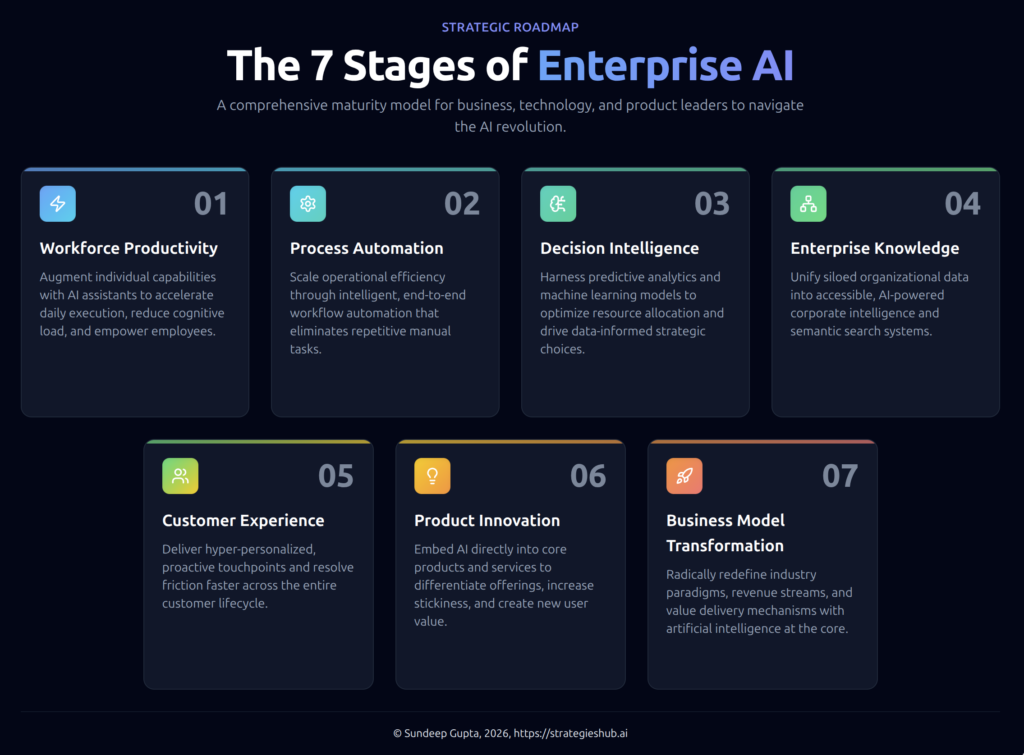
1. Workforce Productivity
Objective: Enable employees to accomplish more work with less effort.
Examples:
- Coding assistants
- Knowledge assistants
- Meeting summarization
- Document drafting
- Research copilots
Business outcome:
- Higher productivity
- Faster execution
- Reduced administrative burden
This is often the easiest starting point because it requires minimal process redesign.
2. Process Automation
Objective: Automate repetitive and rule-driven workflows.
Examples:
- Invoice processing
- Claims processing
- Contract review
- Ticket classification
- Data extraction
Business outcome:
- Lower operating costs
- Faster turnaround times
- Improved consistency
This strategy focuses on efficiency rather than innovation.
3. Decision Intelligence
Objective: Improve the quality and speed of business decisions.
Examples:
- Demand forecasting
- Risk assessment
- Fraud detection
- Inventory optimization
- Sales forecasting
Business outcome:
- Better decisions
- Reduced risk
- Increased profitability
The human remains accountable; AI augments decision-making.
4. Enterprise Knowledge
Objective: Unlock organizational knowledge and expertise.
Examples:
- Enterprise RAG systems
- Internal chat assistants
- Technical support assistants
- Policy assistants
Business outcome:
- Faster knowledge discovery
- Reduced onboarding time
- Less dependence on subject matter experts
Many enterprises are currently investing heavily in this area.
5. Customer Experience
Objective: Enhance customer interactions and engagement.
Examples:
- Personalized recommendations
- AI-powered support
- Conversational commerce
- Intelligent onboarding
Business outcome:
- Higher customer satisfaction
- Increased retention
- Revenue growth
This strategy is externally focused rather than internally focused.
6. Product Innovation
Objective: Embed AI directly into products and services.
Examples:
- AI-powered CRM features
- Intelligent search
- Content generation features
- Automated analytics
Business outcome:
- Product differentiation
- Increased product value
- Competitive advantage
This is where AI becomes part of the product rather than a supporting capability.
7. Business Model Transformation
Objective: Create new ways of operating and generating revenue.
Examples:
- AI-native products
- AI marketplaces
- Autonomous service delivery
- AI-powered education platforms
- AI-based advisory services
Business outcome:
- New revenue streams
- New business models
- Strategic differentiation
This is the most ambitious and transformative strategy.
An Eighth Strategy Emerging in 2026
Many large organizations are now adopting:
AI Sovereignty
Objective: Own and control AI infrastructure, models, and data.
Examples:
- Self-hosted LLMs
- Private AI clouds
- On-premise inference clusters
- Internal model registries
Business outcomes:
- Data control
- Regulatory compliance
- Reduced vendor dependency
- Long-term cost optimization