
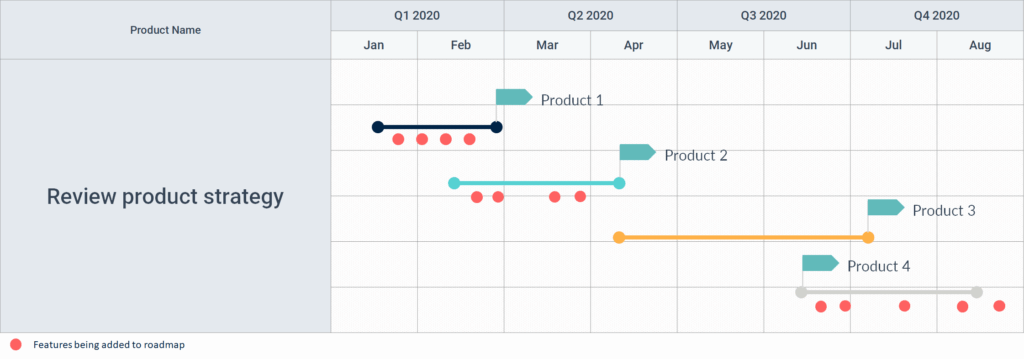
Product managers often struggle while creating and maintaining an impactful product roadmap. Product managers add potential features that they cannot immediately prioritize to a product roadmap. The product roadmap often serves as a placeholder in such a context. Over a period of time, the product managers end up cluttering the roadmap with both important and less important items. Product managers usually struggle to remove features from this roadmap because they know that these might regain importance sometime in future cycles. As a result, organizations often struggle in executing product roadmaps effectively.
Stakeholders often fail to interpret the product roadmaps because it’s too cluttered. Product managers need to republish the roadmap every month or every quarter to ensure every stakeholder is aligned.
As a solution, organizations need a simple and executable process to manage roadmaps. A Value Based Framework helps product managers stay aligned with business values and deliverable outcomes. This framework is intuitive and practical, enabling all stakeholders to easily understand product roadmaps. Product managers can easily explain why they have included certain features in a roadmap and excluded others.
The framework ensures that resources are optimally directed toward initiatives that generate the greatest impact. The process ensures that less important features are identified early and hence do not become a part of a roadmap. The framework builds a high level of transparency. Every stakeholder easily understands why features have been included or excluded in the overall prioritization exercise.
Value Based Framework
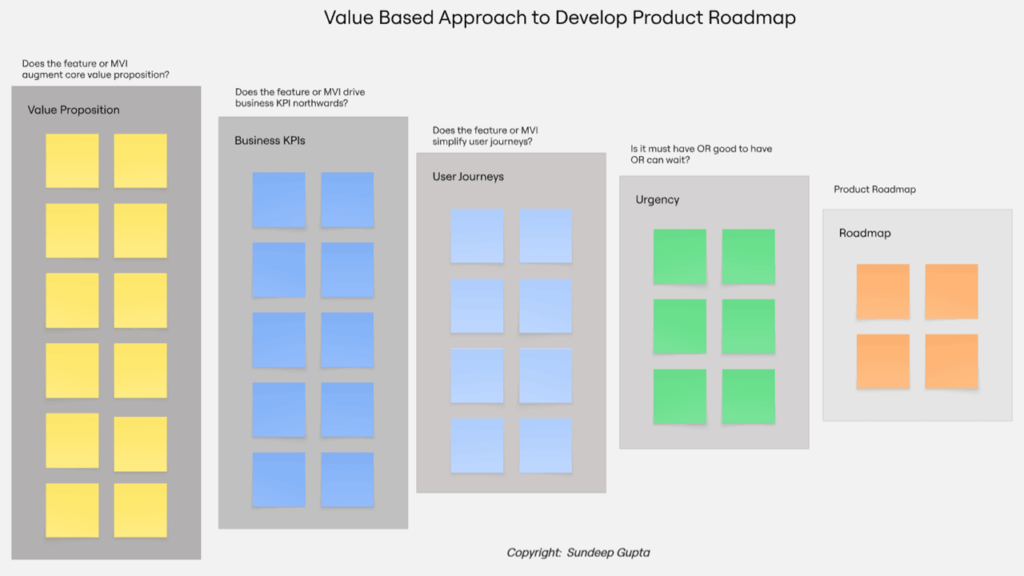
Every feature or minimum value increment (MVI) is evaluated through a four-stage funnel that ensures that only the most valuable initiatives make it to a product roadmap. These stages are as follows:
- Value Proposition – is the value proposition of the feature or MVI aligned with the core value proposition of the larger product?
- Business KPI – does the feature or the MVI help achieve business KPI(s)?
- User Journey – does the feature or the MVI simplify the current user journey?
- Urgency – is the feature or the MVI is so urgent that it should be built or it can wait?
If the answer to all the above stages is a resounding YES, then the feature or the MVI is included in the product roadmap; otherwise, it’s excluded. Product managers can easily identify challenges encountered by features or MVIs which are not included in a product roadmap. Such challenges can easily be articulated to all stakeholders, there by reducing the friction and improving transparency.
PMs must keep revisiting their roadmaps and reapply the framework to assess if those items are still relevant. After all, what was important last year may no longer be a priority this year.
Why this framework might work?
The above framework is flexible and incorporates four layers of checks before a feature or MVI is included in a prodouct roadmap.
Essentially, the framework:
- Helps product managers stay ultra-focussed. This is extremely important when they are running tight deadlines or the organization is short staffed.
- Empowers product managers to say “No” to requirements – even when they come from powerful stakeholders.