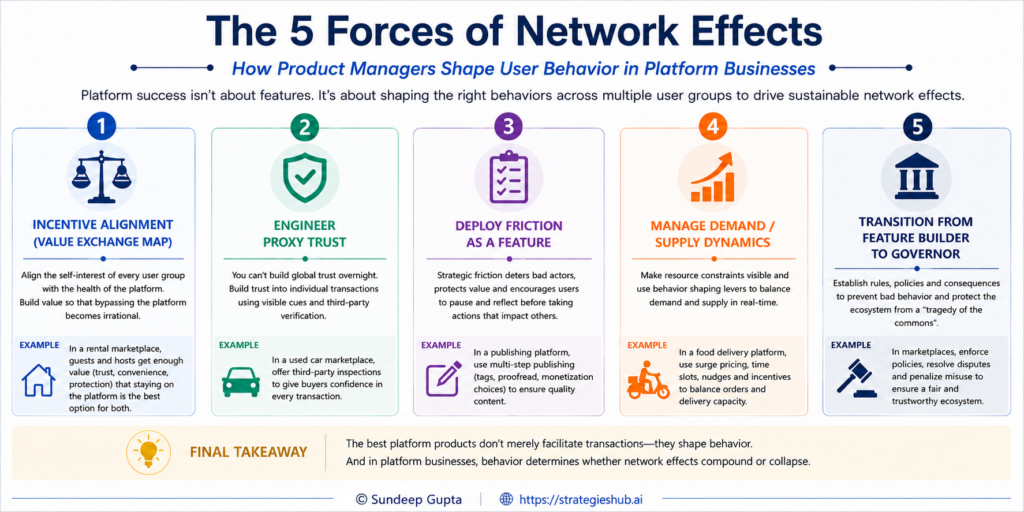
Summary: Multi-party platforms succeed not because of better features, but because they shape user behavior in ways that strengthen network effects. Product managers must align incentives, engineer trust, introduce strategic friction, balance supply and demand, and govern the ecosystem effectively. When these forces work together, network effects compound; when they don’t, the ecosystem gradually breaks down.
Most product managers spend their careers optimizing screens, workflows, and features. Platform product management is different. It requires shaping the behavior of multiple independent user groups whose interests are often misaligned—and creating the conditions for network effects to thrive.
Whether it’s buyers and sellers, drivers and riders, or suppliers and customers, a seemingly small product change can trigger ripple effects across an entire ecosystem. Product Managers should be able to successfully manage the butterfly effect.
Over the years, I have found five recurring principles that determine whether a platform scales sustainably or becomes increasingly difficult to manage.
Traditional product management focuses on optimizing user journeys. Platform product management focuses on optimizing interactions between user groups.
In this article, I will discuss the following:
1. Incentive Alignment (Value Exchange Map)
Imagine you are a product leader at an online marketplace which connects home owners to rent their property to guests for short and long term stay (something similar to Airbnb). You notice that guests browse the property, download the details and book the property off platform eventually bypassing your platform. The guest pays a lower rate, the property owner does not have to part with 20% commission and your platform loses its revenue.
The immediate reaction is to hide phone numbers. But the root cause is that the incentives are not aligned.
Every platform relies on a Value Exchange Map – a formal mapping of who gives what to whom, and who gets what in return. A balanced value exchange map has to ensure that value creation is sustainable over a long period of time. When the platform is unbalanced, one user group feels “used” or “overcharged”, causing the network effects to collapse.
Strategic Shift – don’t build features that force compliance. Instead, build value so that bypassing the platform becomes irrational. Align self-interest of every user group with the health of the platform.
2. Engineer Proxy Trust
Imagine you are buying a five year old used car on an online platform. You visit an independent car dealer, inspect the car and verify all the documents. Despite ticking every item in your checklist, you are still skeptical with an inherent lack of trust. Contrast this with buying a new car from an established brand; you feel safe because information is symmetrical.
User groups usually refrain from either cooperating at all under lack of trust or cooperate with the “bare minimum” requirements because they do not trust each other.
You cannot fix the “global trust” on your platform overnight, but can build proxy trust into individual transactions. These are visible stand-ins or cues (proxies) to gauge the trustworthiness of other user groups.
For e.g. in the above case of buying used car, don’t just ask the seller to be honest. Embed a feature on the platform to get a car inspected by an independent 3rd party agency. This is built as part of the buying user journey.
Strategic Shift – By creating trusted transactional cues, you can give users a psychological safety required to engage deeply.
3. Deploy Friction As Feature
As PMs, we are brainwashed to remove friction. We optimize for one-click checkouts, seamless sign-ups and sign-ins. But on a platform, strategic friction is often a good strategy against an ecosystem decay.
Consider a publishing platform like Medium. If you make publishing a single click activity, you have optimized for speed but inadvertently incentivized low effort and spammy content. Over time, poor curation will drive away readers, which will eventually drive away high quality content creators.
To protect your ecosystem, add a multi-step wizard (friction) before publishing any content:
- Mandatory tagging for better SEO and audience discovery
- Proof read the content forformatting integrity
-
Opt in/out for monetization
Strategic Shift – Strategic friction deters bad actors, protects value and forces users to pause and reflect before executing an action that can impact other user groups.
4. Manage Demand / Supply Dynamics
If you lead a hyper-local food/grocery delivery platform, you must be balancing the peak hours rush for high orders and shortage of delivery executives. Delays happen which leads to downgraded customer experience.
Product Managers must build mechanisms that should make scarcity visible. Instead of treating it as an operational challenge, solve it through behavior shaping strategies:
- Implement dynamic pricing or surge pricing
- Offer discount vouchers to customers who willingly accept longer delivery schedules
-
Implement product nudges such as “A delivery executive leaving for your neighborhood in next 10 minutes. Order now!”
Strategic Shift – Scarcity is a behavioral design problem. Users make better decisions when resource constraints are transparent.
5. Transition From Feature Builder To Governer
Ultimately, a platform product manager acts less like an engineer and more like a central bank governor. You are creating a micro-economy, which requires robust platform governance.
Governance is the set of rules, policies, and systemic consequences designed to prevent a “tragedy of the commons”—where individual greed ruins a shared resource for everyone.
Whether it’s Amazon introducing a “Trust Shield” vendor warranty for high-value purchases or eBay managing dispute resolutions, your platform needs a judicial system. When bad behavior goes unpunished, good actors leave.
Final Thoughts
Shaping behavior in a platform requires you to look beyond the immediate user on the screen. The best platform products don’t merely facilitate transactions—they shape behavior. And in platform businesses, behavior determines whether network effects compound or collapse.
Every button you add and every workflow you optimize has a ripple effect across the entire network. Focus on the value exchange, orchestrate trust, lean into strategic friction, and govern your ecosystem with intent. That is how you turn a volatile platform into an unstoppable network effect.
Most product teams compete through features. The most successful platforms compete through behavior design. Features create transactions. Behavior creates network effects. And network effects create enduring advantage.