AI is usually discussed as a source of new product value. It can automate work, improve experiences, reduce costs, and enable capabilities that were previously impossible.
But there is another side to the story.
AI can reduce product value in ways that are not immediately visible—by weakening differentiation, increasing verification effort, disrupting pricing models, and making alternatives easier to build.
It can make differentiated capabilities easier to copy, reduce switching costs, undermine pricing models, increase the burden of verification, and make custom alternatives cheaper to build.
For product managers, the question is:
Where should we add AI?
Which assumptions about our product’s value could AI invalidate?
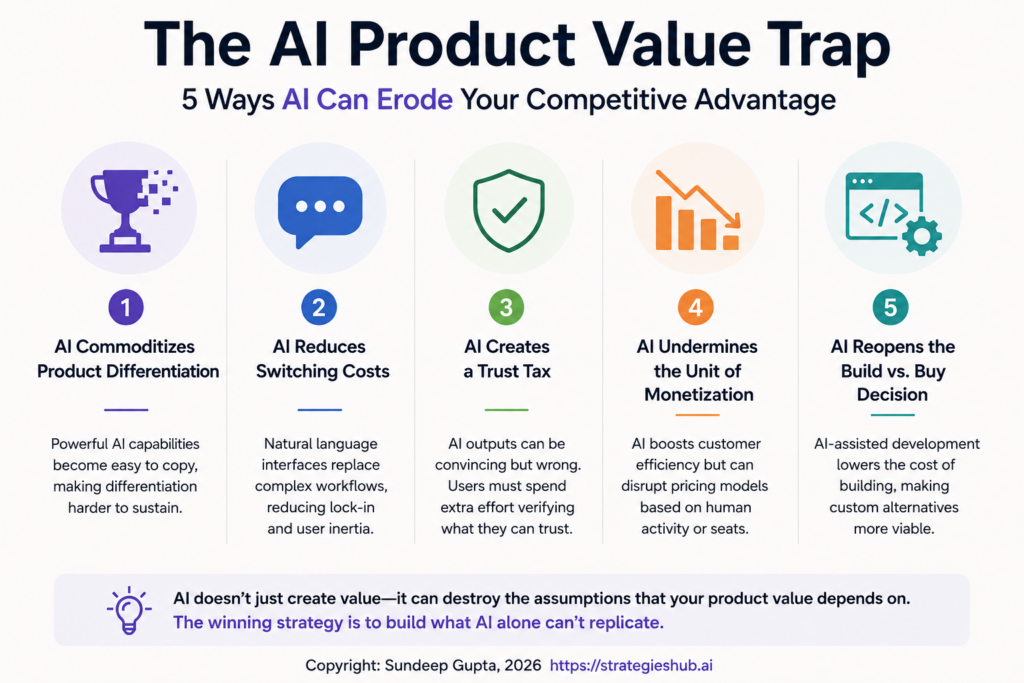
Here are five ways the AI product value trap can emerge.
1. AI Product Value - Commoditization Trap
The generative AI boom showed how quickly an impressive capability can become ordinary.
Before ChatGPT became widely available, companies such as Jasper and Copy.ai built successful products around AI-generated marketing content. They offered more than a text-generation interface—templates, workflows, collaboration, and brand controls were part of the experience.
However, ChatGPT made powerful text generation directly accessible to millions of users. Generic AI writing became easier to replicate, weakening its value as a standalone differentiator.
Jasper and Copy.ai did not become irrelevant overnight. But both increasingly expanded toward broader enterprise workflows, marketing automation, and business-specific use cases.
The lesson is not that products built on foundation-model APIs cannot succeed. It is that access to a model is rarely a durable advantage when competitors can access the same model.
The value must come from what surrounds the model:
- Proprietary context
- Domain expertise
- Embedded workflows
- Trusted integrations
- Governance
- Distribution
- Measurable outcomes
If every competitor had access to the same model tomorrow, what would still make your product difficult to replace?
2. AI Can Reduce Interaction-Based Lock-In
Users often become attached to software because they have invested years learning how to use it.
They understand the interface, navigation, reports, commands, and product-specific workflows. That knowledge creates a switching cost—even when the product is difficult to use.
AI can weaken this advantage by replacing specialized interactions with natural language.
Consider business-intelligence software. Traditionally, a business user may need to understand dashboards, filters, data models, or specialized query languages to answer a question.
AI changes the interaction:
“Show me Q3 revenue by region and compare it with last year.”
The system can interpret the request, generate a query, retrieve the data, and create a visualization.
This does not make BI platforms interchangeable. Data models, governance, security, integrations, and organizational workflows still matter.
But the interaction layer becomes less proprietary.
Are customers staying because your product creates unique value—or because they have invested years learning how to use it?
A complex interface may create friction, but friction is not the same as a moat.
3. AI Can Create a Trust Tax
Generative AI can produce useful and convincing outputs while still being incorrect.
That creates a cost that is often missing from AI business cases:
How much effort must users spend deciding whether an AI-generated answer can be trusted?
I think of this as the trust tax.
The Mata v. Avianca case made this risk visible. Lawyers submitted court filings containing fictitious legal citations generated using ChatGPT. The court later imposed sanctions.
The lesson is not merely that the model made an error. The output looked credible enough to be used without adequate verification.
AI reduced the effort required to generate legal arguments, but it did not eliminate the need to validate them.
If users must carefully check every output, some of the productivity gained during generation may be lost during verification.
Does the AI remove work—or does it move work from execution to verification?
Product managers should consider how users can validate outputs, understand uncertainty, and access supporting evidence. The goal is not to eliminate human oversight. It is to make verification proportional to the risk of the decision.
4. AI Can Undermine the Unit of Monetization
AI can improve customer productivity while putting pressure on the pricing model of the product delivering that value.
Many SaaS products charge based on human activity:
- Users
- Seats
- Agents
- Analysts
- Recruiters
But AI can reduce the number of people required to achieve the same business outcome.
Klarna demonstrated this in early 2024 when it announced that its AI customer-service assistant had handled 2.3 million conversations in its first month. According to the company, the assistant performed work equivalent to 700 full-time agents and reduced average resolution time from approximately eleven minutes to less than two minutes.
That is a major productivity improvement.
But imagine a customer-service platform that earns most of its revenue through per-agent pricing. If customers need fewer agents, the vendor may sell fewer seats.
The demand for customer service has not disappeared. The value may simply have shifted toward:
- Automated resolutions
- AI conversations
- Successful outcomes
- Knowledge quality
- Orchestration
AI may not destroy the market. It may destroy the unit used to monetize the market.
If AI makes your customers ten times more efficient, does your pricing model benefit—or suffer?
5. AI Is Reopening the Build-vs-Buy Decision
For years, the enterprise-software rule was simple:
Build what is strategically unique. Buy everything else.
Custom software was expensive because it required engineering talent, product design, testing, infrastructure, security, and ongoing maintenance.
AI-assisted development is changing that calculation.
Tools such as GitHub Copilot, Cursor, and Claude Code can help teams generate code, create interfaces, explain systems, and accelerate development.
This does not mean enterprises can replace mature SaaS products with secure, production-grade systems over a weekend. Security, governance, integrations, reliability, and long-term ownership remain difficult.
But AI does lower the cost of building useful internal applications—especially products that are narrow, lightly integrated, and based on standard workflows.
The competitive threat is no longer limited to another SaaS vendor.
It may come from the customer’s own engineering or IT team.
The important question is not:
“Can a customer rebuild our entire product?”
It is infact,
Can a customer build a good-enough version of the part they actually use?
If the answer is yes, the product may face new substitution pressure.
The strongest defense is not necessarily more features. It is deeper value that is difficult to reproduce:
- Proprietary data
- Domain expertise
- Enterprise reliability
- Security and compliance
- Embedded workflows
- Integrations
- Operational maturity
AI may make code easier to generate. It does not automatically make a trusted and deeply integrated product easy to reproduce.
The Bigger Pattern
These risks are connected.
AI can make capabilities easier to copy, interfaces easier to replace, human effort easier to automate, and custom software easier to build. It can also create a new verification burden.
In each case, AI changes an assumption that previously supported product value.
That is why AI product strategy cannot be reduced to adding features to a roadmap.
A new AI capability may look valuable in isolation while weakening the product at a system level.
Before adding AI, product managers should ask:
- Differentiation: If competitors have the same model, what remains unique?
- Switching costs: Are customers retained by value or by learning effort?
- Trust: Does AI remove work or shift it to verification?
- Monetization: Does AI strengthen or weaken the pricing model?
- Build vs. buy: Could customers now build a good-enough alternative?
Conclusion
AI is not inherently destructive to product value. It can create extraordinary value when it improves outcomes and removes friction.
But it can also weaken the foundations on which products were built.
The strongest AI-era products will not necessarily be the ones with the most AI features. They will be the products that own what AI alone cannot commoditize:
- Proprietary context
- Trusted data
- Deeply embedded workflows
- Domain expertise
- Governance
- Distribution
- Measurable customer outcomes
The question for product managers is not simply:
Where should we add AI?
It is:
Which assumptions about our product’s value will AI invalidate—and what will remain valuable when the AI capability itself becomes commonplace?
That is the real AI product value trap.