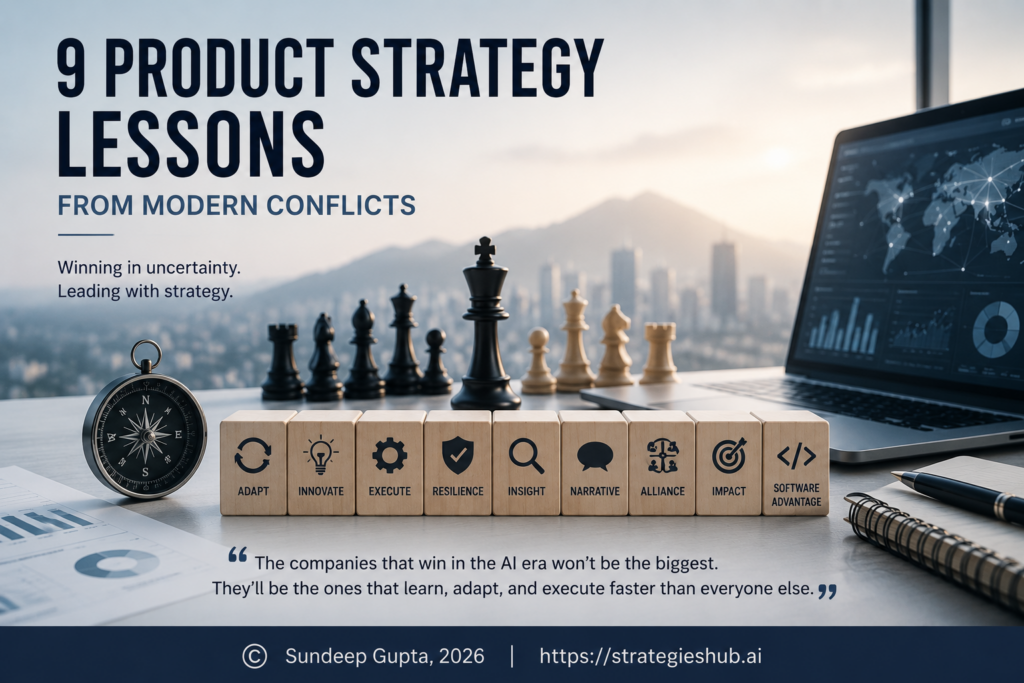
Modern conflicts are among the most complex environments for strategic decision-making. They unfold under extreme uncertainty, where information is incomplete, technology evolves rapidly, resources are constrained, and assumptions become obsolete overnight. While businesses compete for customers rather than territory, the underlying strategic challenges are remarkably similar. Whether you are launching an AI startup, leading a product portfolio, or defending a market-leading position, success increasingly depends on how quickly you learn, adapt, allocate resources, build resilience, and shape the narrative. This article is not about military history or geopolitics. Instead, it explores nine timeless product strategy lessons that every product leader can draw from recent geopolitical conflicts such as the Russia–Ukraine war and the U.S.–Iran conflict—lessons that are becoming increasingly relevant in an AI-driven world where the pace of change has never been faster.
1. Adaptation beats initial superiority
Russia entered Ukraine with overwhelming military advantages. Ukraine had fewer soldiers, fewer aircraft and fewer tanks.
Ukraine’s strategic advantage was quick adaptation. Ukraine quickly and continually adapted every few weeks with new drone tactics, new electronic warfare, improved logistics support etc.
The side that learned faster kept surviving.
Product Lesson
The first version of your product almost never wins. The company that learns faster wins.
Instead of asking
“Can we build the perfect AI product?”
Ask
“Can we learn twice as fast as everyone else?”
Learning velocity > engineering velocity.
2. Expensive systems lose against intelligent low-cost innovation
Ukraine repeatedly destroyed multi-million-dollar tanks using drones costing hundreds or thousands of dollars. Similarly, Iran used low-cost kamikaze drones and destroyed high value targets. Inexpensive autonomous systems have changed military economics completely. This is a lesson for all the militaries of the world.
Product Lesson
A startup should never compete on size. Instead, it should compete on economics.
Examples:
- Instead of building “Salesforce”, build an “AI CRM Agent”.
- Instead of hiring 100 salespeople, build AI SDR.
If you are already a market leader, keep innovating to lower your unit economics and/or improve your product value. It might not take longer before you face a new low-cost challenger.
3. Logistics wins wars
Both the conflicts repeatedly showed that ammunition, spare parts, fuel, transportation and supply chains are as important as any battlefield tactics.
Product Lesson
Founders are usually obsessed with features. But customers care about
- Quick Onboarding
- Seamless Deployment
- Instant Integrations
- Customer success
Those are your logistics. Many startups fail not because the product is bad. They fail because the logistics is poor.
4. Resilience beats efficiency
Just-in-time supply chains looked efficient before these two conflicts. Both the wars have exposed how brittle they could be in case of crises. Now, leading organizations have been forced to rethink redundancy and resilience strategies in addition to just being efficient.
Product Lesson
Don’t optimize everything for efficiency. As a strategist:
- Cash reserves – helps businesses stay afloat when sales drop
- Engineering slack – creates bandwidth to experiment with new ideas or fix urgent issues
- Multiple cloud regions – you just cannot rely on one cloud region. You should have ability to quickly redeploy your solution in another region
- Backup suppliers – political strategies (e.g. tariffs) can render suppliers being unavailable. Always have approved secondary or backup suppliers and improve resiliency
- Multiple data sources – Imagine your data sources being acquired by your competitor. In a short term, a prudent product strategy should have planned multiple data sources.
Efficiency maximizes profit while resiliency maximizes survival. When economies are getting conservative, product managers will have to plan alternate strategies for being resilient.
5. Information warfare became a battlefield
These recent conflicts showed the importance of narratives. A narrative influences:
- Allies
- Public support
- Funding
- Morale
- Diplomacy
Information has become part of the conflict itself.
Product Lesson
Building the best product isn’t enough. You must own the narrative. In the current era of AI, marketing has become critical for awareness, hyper-personalization, and value communication. Product strategists should reevaluate the marketing strategies so that they can continuously sense the fast-changing customer insights, create bespoke messaging, and deliver value.
For example:
- Hubspot coined the term “Inbound Marketing” in 2005. Their narrative argued that traditional outbound marketing strategies (e.g., cold calling, ads, campaigns, etc.) were dead, and companies should attract customers by creating helpful content.
- Qualtrics started as a basic academic survey tool. Realizing that surveys were getting commoditized, they wrapped their product in a massive narrative called “Experience Management”. This narrative helped them move beyond simple survey links and own an ecosystem where enterprises can continuously listen to any broken experience across the customer’s value chain.
Your story and narrative matters.
6. Capability Beats Scale
One of the defining characteristics of recent geopolitical conflicts is that battlefield outcomes are no longer determined solely by the size of an army or the value of its military assets. Smaller, agile forces equipped with the right technology, intelligence, precision weapons, and autonomous systems have repeatedly demonstrated the ability to challenge much larger and better-funded adversaries. Whether through drones, cyber operations, electronic warfare, or precision strikes, modern conflicts have shown that capability can outweigh scale.
The strategic lesson is clear: size provides an advantage only when it can be translated into speed, precision, and effective execution. Large organizations often struggle with coordination, bureaucracy, and slower decision-making, while smaller teams can adapt and respond much faster.
Product Lesson
The same principle applies to product strategy.
Large organizations have more engineers, larger budgets, and established brands. Startups have agility.
Rather than competing on scale, product leaders should compete on differentiated capabilities that incumbents struggle to replicate.
This could mean:
- Building AI-first products instead of adding AI as another feature.
- Automating workflows that competitors still execute manually.
- Delivering a superior customer experience through intelligent personalization.
- Making decisions faster by using real-time product intelligence instead of quarterly planning cycles.
Customers rarely choose a product because the company has the largest engineering team. They choose the product that solves their problem faster, better, and more efficiently.
In today’s AI era, competitive advantage belongs not to the organization with the greatest resources, but to the one that converts technology into unique capabilities that customers genuinely value.
7. Integration Becomes the Strategic Advantage
Recent geopolitical conflicts have demonstrated that military superiority is no longer determined solely by the number of tanks, aircraft, missiles, or soldiers. Increasingly, success depends on how effectively these assets are connected, coordinated, and managed through software.
Modern warfare is built on a continuous flow of information from satellites, drones, surveillance systems, intelligence networks, communication systems, and command centers. Software integrates these independent systems into a unified decision-making platform, enabling commanders to detect threats, coordinate resources, and respond to changing situations much faster than before.
In many situations, the same physical assets can produce vastly different outcomes depending on the quality of the software that connects and orchestrates them. The competitive advantage is no longer just owning better assets—it is making better decisions with those assets.
Product Lesson
The same transformation is taking place across industries.
Whether you manufacture automobiles, operate a bank, manage a retail chain, build medical devices, or develop enterprise software, competitive advantage increasingly comes from how well you integrate data, processes, people, and technology into a single operating system for the business.
Customers no longer evaluate products in isolation. They evaluate the complete experience—from purchasing and onboarding to service, upgrades, support, and continuous improvement. Organizations that treat software merely as a supporting function often struggle to keep pace with competitors that use software to orchestrate their entire value chain.
For product strategists, this requires a shift in thinking.
Instead of asking:
“How do we build a better product?”
Ask:
“How do we build a better system?”
The winners will not necessarily be those with the best individual products. They will be the organizations that connect products, services, operations, partners, and customer interactions into a continuously improving ecosystem.
8. Sustained Execution Beats Breakthrough Innovation
Recent geopolitical conflicts have shown that a single technological breakthrough rarely determines the outcome of a prolonged conflict. Success depends on the ability to continuously manufacture, replenish, deploy, repair, and improve capabilities over an extended period. Even the most advanced technology loses its strategic value if it cannot be produced, maintained, and deployed at scale.
The strategic lesson is clear: innovation creates an initial advantage, but sustained execution determines long-term success.
Product Lesson
The same principle applies to product strategy.
Launching an innovative product or introducing a groundbreaking feature may generate excitement, but lasting market leadership depends on an organization’s ability to execute consistently.
Winning products are built through a repeatable operating rhythm of understanding customer needs, delivering meaningful improvements, maintaining reliability, responding to market changes, and scaling operations as demand grows.
Product leaders should therefore spend as much time building execution capabilities as they do generating new ideas.
This includes:
- A disciplined product development process.
- Reliable engineering and release practices.
- Strong customer support and success functions.
- Efficient go-to-market execution.
- Continuous feedback and improvement loops.
History has shown that many companies were first to innovate but failed to dominate their markets because they could not scale or sustain execution. Conversely, market leaders often succeed by consistently delivering value long after the initial innovation has faded.
For product strategists, the lesson is simple:
Innovation earns attention. Sustained execution earns market leadership.
9. Tactical Victories Do Not Guarantee Strategic Success
History has repeatedly shown that nations can win numerous battles yet fail to achieve their strategic objectives. Tactical excellence without strategic alignment often leads to prolonged conflicts, increasing costs, and diminishing returns. The ultimate measure of success is therefore not the number of battles won, but whether every action advances the long-term political and military objective.
The recent geopolitical conflicts, including the Russia–Ukraine war and the U.S.–Iran conflict, reinforce this principle. Precision strikes, destruction of high-value assets, cyber operations, and technological superiority can create significant tactical advantages. However, these individual successes do not automatically translate into strategic victory. Military leaders must continuously evaluate whether each tactical decision contributes to the broader objective or merely delivers a short-term win.
This distinction between tactical success and strategic success is one of the most important lessons for product strategists.
Product Lesson
Businesses often celebrate tactical victories:
- Launching a new feature ahead of competitors.
- Integrating the latest AI capability.
- Winning a marquee customer.
- Growing monthly active users.
- Expanding into a new market.
Each of these achievements is valuable, but none of them guarantees long-term success unless it strengthens the company’s strategic position.
Great product leaders evaluate every initiative through a simple but powerful question:
Does this move us closer to our long-term product vision and strengthen our competitive advantage?
A feature that delights one customer but complicates the product architecture, an AI capability that generates publicity without solving a meaningful customer problem, or rapid market expansion without operational readiness may all represent tactical wins that weaken the long-term strategy.
The role of a product strategist is therefore not to maximize the number of initiatives, but to ensure that every investment of time, engineering effort, and capital reinforces a coherent product strategy.
In both geopolitics and business, tactical victories create momentum. Strategic alignment determines who ultimately wins.
Conclusion: Winning in Uncertain World
The recent geopolitical conflicts remind us that strategy is ultimately tested under uncertainty. Plans become obsolete, technologies evolve, and assumptions change faster than anyone expects. In such an environment, success is rarely determined by who starts with the greatest resources. It belongs to those who learn faster, adapt sooner, execute consistently, and remain focused on their long-term objectives.
The same principle applies to product strategy. Markets evolve, customer expectations shift, and disruptive technologies continuously redefine the competitive landscape. Winning products are not built by organizations that simply innovate more—they are built by organizations that continuously adapt while staying true to a clear strategic vision.
Whether on the battlefield or in the boardroom, the winners are not necessarily the biggest or the strongest. They are the ones that combine adaptability, resilience, disciplined execution, and strategic clarity to navigate uncertainty and create lasting competitive advantage.